
The Maker's Guide to Scaling Artisan Chocolate Without Losing That Small-Batch Soul
You've nailed the craft. Your single-origin bars fly off farmers' market tables. Your truffles have a cult following. Now comes the scariest question every artisan chocolate maker faces: Can I grow without losing what made my chocolate special in the first place?
Here's the truth nobody tells you, scaling isn't about choosing between "artisan" and "commercial." It's about building systems that protect your soul while expanding your reach. And yeah, it's absolutely possible to make 500 bars a week with the same obsessive care you put into making five.
Let's talk about how to do it right.
The Fork in the Road: In-House vs. Co-Manufacturing
Before you buy a single piece of new equipment, you need to answer the big strategic question: Are you scaling in-house or partnering with a co-manufacturer?
In-house scaling means you maintain complete control, every roast profile, every conche time, every tempering curve stays under your watchful eye. This path is non-negotiable if your brand identity centers on hands-on craftsmanship and origin-to-bar transparency. You can pivot quickly, test wild flavor experiments on Wednesday and launch them Friday, and tell customers with absolute certainty, "I made this."
Co-manufacturing offers speed and market flexibility. You can enter retail channels or launch in new regions without building infrastructure from scratch. But you're trading some control for capacity, and if your brand promise is "made by me in my kitchen," that narrative gets complicated fast.
Neither path is wrong. The key is choosing the one that aligns with your competitive advantage. If customers buy from you because they trust your hands, stay in-house. If they buy because they love your flavor vision and you can maintain quality standards through partnership, co-manufacturing might unlock growth you'd never achieve solo.
Precision Over Volume: The Equipment Mindset
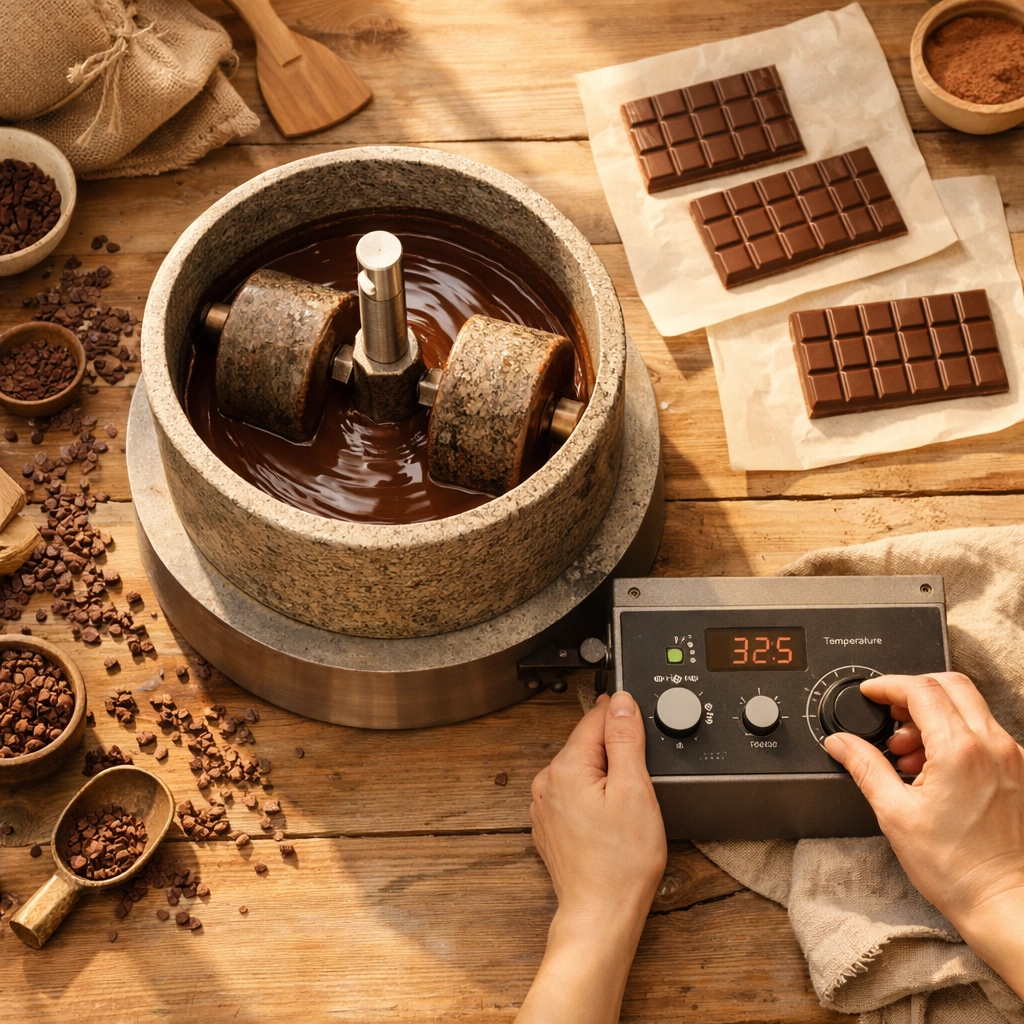
Here's where makers get tripped up: They think scaling means buying bigger equipment. Wrong. Scaling means buying more precise equipment that can replicate your small-batch quality at higher volumes.
Take refining. Belgian chocolatiers achieve particle sizes of 18-20 micrometers, that's the texture difference between "homemade chocolate" and "holy-wow-that's-smooth chocolate." At small scale, you might hit that with patience and a decent melanger. At higher volumes, you need equipment with consistent pressure, temperature control, and predictable timing.
Same goes for conching. Some European makers conch for up to 78 hours to develop flavor complexity and remove volatile acids. Can you do that in a kitchen-scale machine? Sure. Can you do it in three machines simultaneously without babysitting them 24/7? That requires systems.
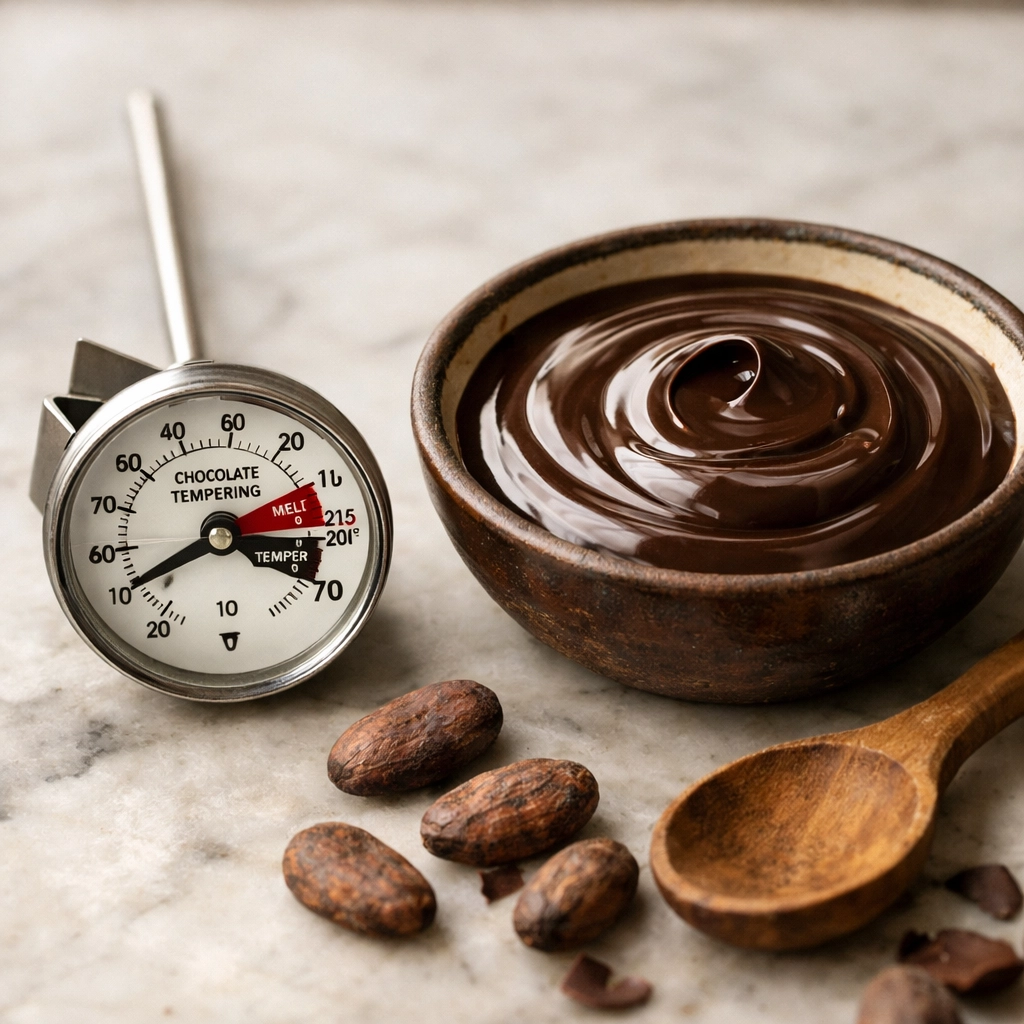
And tempering, oh, tempering. The seeding method is your friend here. It's beginner-friendly, scalable, and forgiving, which matters when you're training staff or running multiple batches back-to-back. Seeding involves adding small pieces of pre-tempered chocolate to melted chocolate to encourage stable crystal formation. It's cleaner and more consistent than tabling (which gets messy at scale) and doesn't require the precision of a tempering machine for every single batch.
Want to track all this? Our Formulation Tool lets you dial in recipes with ingredient precision, percentages, temperatures, timing, so when you're ready to scale a recipe from 5kg to 50kg, the math is already done. No guesswork. Just consistency.
Build Your Team Like You Build Your Recipes
Equipment is half the equation. People are the other half, and this is where artisan makers often stumble.
You can't scale if you're the only person who knows how to temper correctly. You need ongoing training programs covering machinery operation, food safety protocols, quality control checkpoints, and advanced techniques. Create a certification system so every team member hits the same standards, think of it as recipe development for skill-building.
Cross-training is non-negotiable. When someone calls in sick during holiday production, you can't afford for the entire operation to halt because only one person knows how to run the enrober. Cross-trained teams maintain efficiency during crunch time and prevent burnout.
And please, for the love of cacao, invest in shift management software. Tired people make mistakes. Mistakes ruin batches. Ruined batches kill your margins and your reputation. Balanced schedules with proper rest periods aren't "nice to have." They're essential infrastructure.
The Phased Approach: Test Before You Leap
Don't go from 50 bars a week to 500 overnight. That's how you end up with equipment you don't understand, processes that break down, and chocolate that doesn't taste like your chocolate anymore.
Start with pilot-scale runs. Increase production by 20-30% and watch what breaks. Is your tempering machine struggling to keep up? Are you running out of mold space? Is your cooling tunnel creating a bottleneck?
Identify problems at 75 bars a week, not 500.
Then create a detailed scaling roadmap: milestones, resource allocation, timelines, checkpoint dates. Treat it like a recipe, each phase builds on the last, and you don't skip steps.
Use data to guide decisions. Track production yield, energy consumption, waste levels, and equipment performance at each phase. Our Data Analytics dashboard can help you monitor these KPIs in real-time so you're making decisions based on facts, not gut feelings.
When something works at the pilot scale, document it obsessively. Take photos. Write down timing. Record temperatures. Build a production manual so the process lives outside your head.
Sourcing: The Foundation That Holds Everything Together
You can have perfect equipment, a trained team, and flawless processes, and still fail if your supply chain collapses.
Build strong supplier relationships for the beans, cocoa butter, and specialty ingredients that define your chocolate. As you scale, consistency becomes critical. You can't tell customers "Sorry, this batch tastes different because we had to switch bean suppliers." That's not artisan: that's amateur.
Implement real-time inventory tracking systems to optimize procurement and reduce waste. When you're making five batches a week, you can eyeball your cocoa butter levels. At 50 batches, you need alerts when you're hitting reorder thresholds.
And if you're shipping beyond local markets, invest in cold chain logistics. Temperature fluctuations during transit cause fat bloom, texture issues, and disappointed customers. Scaling isn't just about making more chocolate: it's about delivering consistent quality to more people.

Keeping the Soul: What "Artisan" Really Means
Here's the existential question: When does artisan chocolate stop being artisan?
It's not about batch size. It's about intentionality.
Artisan means you're still making deliberate choices about origin, roast profile, conche time, and flavor development. It means you're not cutting corners to hit a price point. It means quality control isn't "hoping this batch turns out okay": it's a systematic process of tasting, measuring, and refining every single run.
Scaling doesn't dilute craftsmanship. Sloppy scaling does.
If you're maintaining oversight, investing in precision, training your team to care as much as you do, and building systems that protect quality at every step: you're still an artisan. You're just an artisan making more chocolate.
Your Next Move
Scaling is terrifying because it feels like stepping away from the thing you love. But the makers who do it right? They don't lose their soul. They amplify it. They get to share their chocolate with more people, pay their team fairly, and build sustainable businesses that last.
Start small. Document everything. Invest in precision. Build systems. And keep tasting every batch like your reputation depends on it: because it does.
Ready to dial in your scaling strategy? Sign up for a free Cocoa Craft account and access our full suite of production tools: including the Formulation Tool for recipe precision and FactoryLink for production planning. And when you need a break from the serious stuff, hop over to our Game Hub and play Hot Cocoa Rush. Because even makers need to have fun.
Let's scale this thing together. Your chocolate deserves a bigger audience; and the world deserves your chocolate.